Daily needs are not close for everyone.
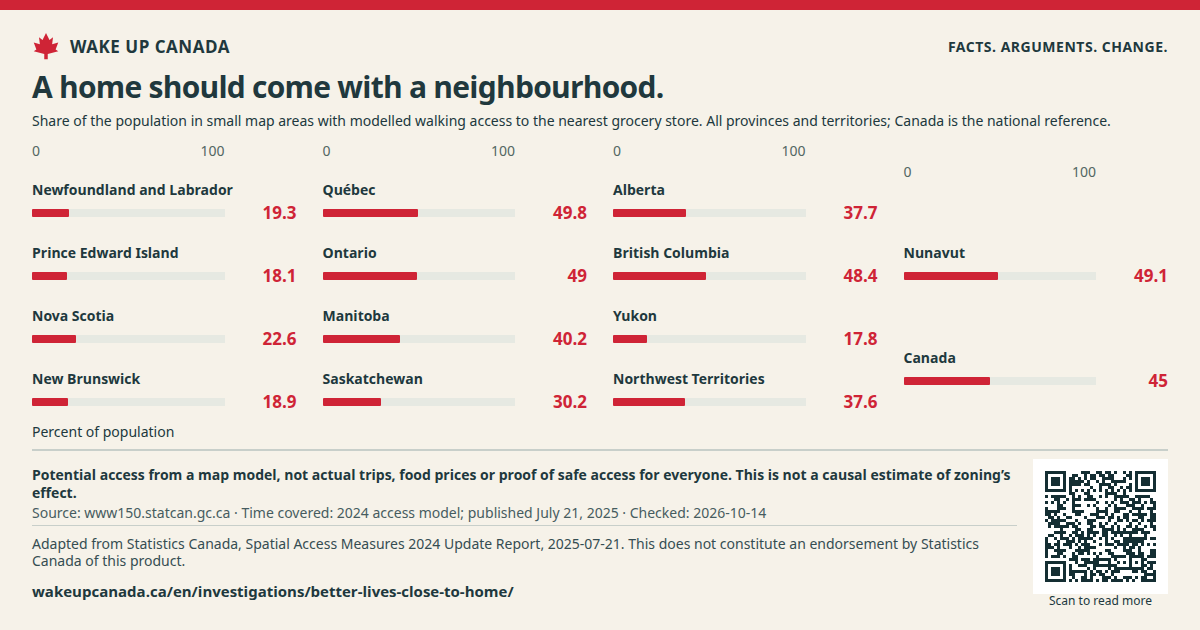
Statistics Canada’s 2024 model places 45% of people within a 15-minute walk of a grocery store. The result uses the population in small map areas, not a survey of trips. [1]
Report · Published
More homes matter. So do shops, safe streets and places to meet. Build places where daily life takes less travel.
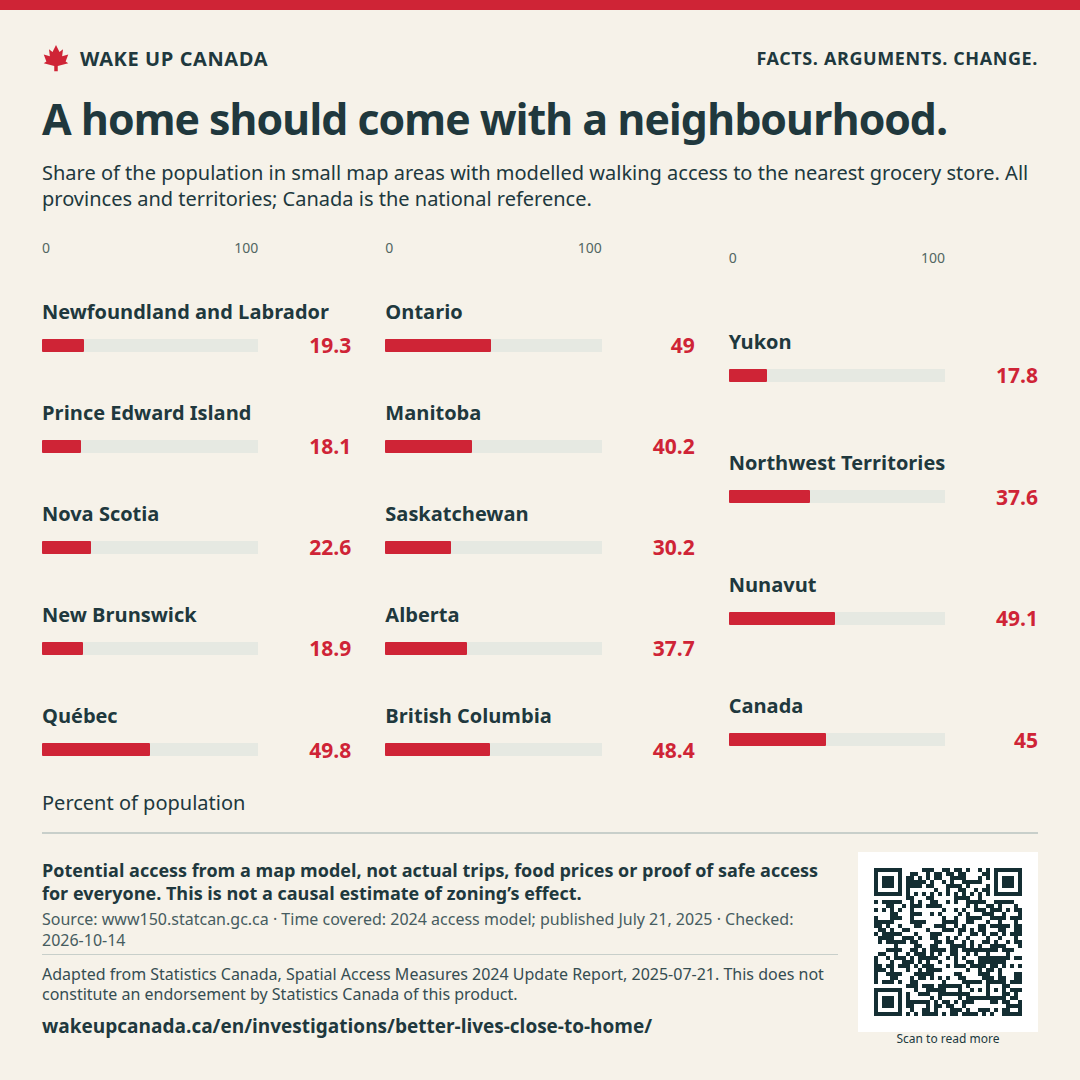
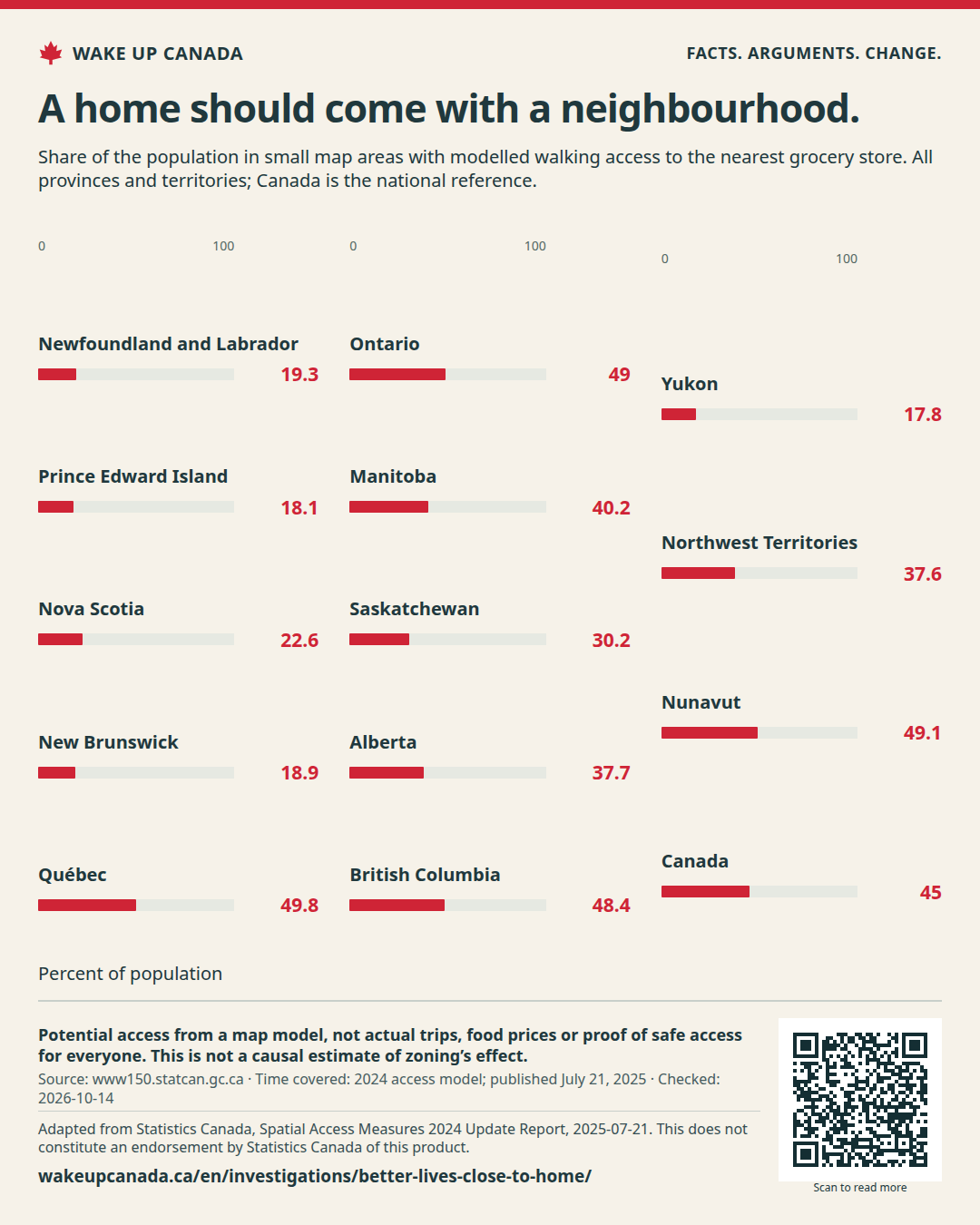
Statistics Canada’s 2024 model places 45% of people within a 15-minute walk of a grocery store. The result uses the population in small map areas, not a survey of trips. [1]
A 2026 review of Canadian studies found promise in walkable places and paths. Many results had low certainty or were mixed. A new path alone does not guarantee more activity. [2]
A cheap home far from daily needs can still come with a costly life. We want homes to rent and buy near shops, work and services. Let more places mix these uses. Give people real choices to walk, roll, cycle, ride or drive.
Allow small homes, flats, local shops and services to share a neighbourhood. Set clear rules for fire, noise, access and harmful uses. Do not make a quiet shop face the same test as a polluting plant.
Make a path to ownership as well as rent. Give small homes a clear route to their own title, safe access and fair shared costs. Homes to rent and homes to buy both belong in the plan.
The chart covers all ten provinces and three territories. It estimates nearby access. It does not say whether the food is cheap or the walk suits a child, older person or wheelchair user.
Map quality can vary by place. A higher share is not a complete quality-of-life score. Use it to find gaps, then check the streets and stores with the people who use them.
[1]Alongside new homes, count rent and purchase costs, travel time, safe crossings, access for disabled people and the cost to run local services. Track whether people with low incomes can stay.
A small town need not look like a big city. Homes near its main street can still bring daily needs closer. Remote places need plans that fit their distances, climate and local choices.
More homes and shops can bring noise, strain pipes or raise land costs. Fix those problems with service plans, safe street design and help for people at risk of losing a home. The health studies do not prove that every denser place is healthier. Test results after the change.
[2]End blanket bans on small homes and harmless local shops. Keep clear rules for real harm.
Join housing plans with safe paths, crossings, transit and access to daily needs. Let people keep the choice to drive.
Publish results for renters and buyers, low-income households, children, older people and disabled people. Track costs as well as new homes.
Local and Indigenous governments, provinces, territories and the federal offices that fund homes and streets.
Street and service work needs a budget. Price each local plan, including upkeep. We do not claim a national savings total.
Share of the population in small map areas with modelled walking access to the nearest grocery store. All provinces and territories; Canada is the national reference.
Percent of population · 2024 access model; published July 21, 2025
Potential access from a map model, not actual trips, food prices or proof of safe access for everyone. This is not a causal estimate of zoning’s effect.
Check the sources: Statistics Canada — Spatial Access Measures 2024 Update Report, Table 5
Source title in English
WAKE UP CANADA
Help more people see the facts and the plan.

More homes matter. So do shops, safe streets and places to meet. Build places where daily life takes less travel.
Keep the source, date and notes with the image.
Checked:
What this does not show: The chart models a walk to a grocery store. It does not measure food prices, safe routes for each person or the effect of zoning alone.
No account needed. Sharing does not sign you up for email.

If the image opens in a new tab, press and hold it or use your browser’s save tool.
This supports the whole cause. Emails are a separate choice.
Support totals are not available right now.
Each email counts once per cause. This does not sign a petition. Your name and email stay private. Only the total is public.
Homes & neighbourhoods · Report
Open the door to useful homes, short trips and more choice. Keep the housing evidence honest.
Read the report ↗Homes & neighbourhoods · Report
Build good homes to rent and a fair path to own. Count the full cost and the risks.
Read the report ↗Homes & neighbourhoods · Report
Our metro areas make a large amount of output. Their success should also mean homes people can afford and shorter daily trips.
Read the report ↗