Our case for change
We want zero tariffs for every country, with no conditions. A tax on parts makes it harder to build here. A tax on safe goods puts a wall between buyers and choice. Keep strong safety rules. End the tax wall.
A border tax reaches home.
An importer pays the tariff at the border. A shop may raise its price, earn less on each sale, or share the cost with its supplier. The split can change. A tariff does not come with a rule that makes a foreign seller pay it.
US studies of the 2018 tariffs found that buyers paid the full tax in import prices. That is a border result, not proof that every shop passed it all on. Canada's 2025 study found a smaller share at the till. Both show why shoppers have a stake in this tax.
[3][2]The tax take is not the whole cost.
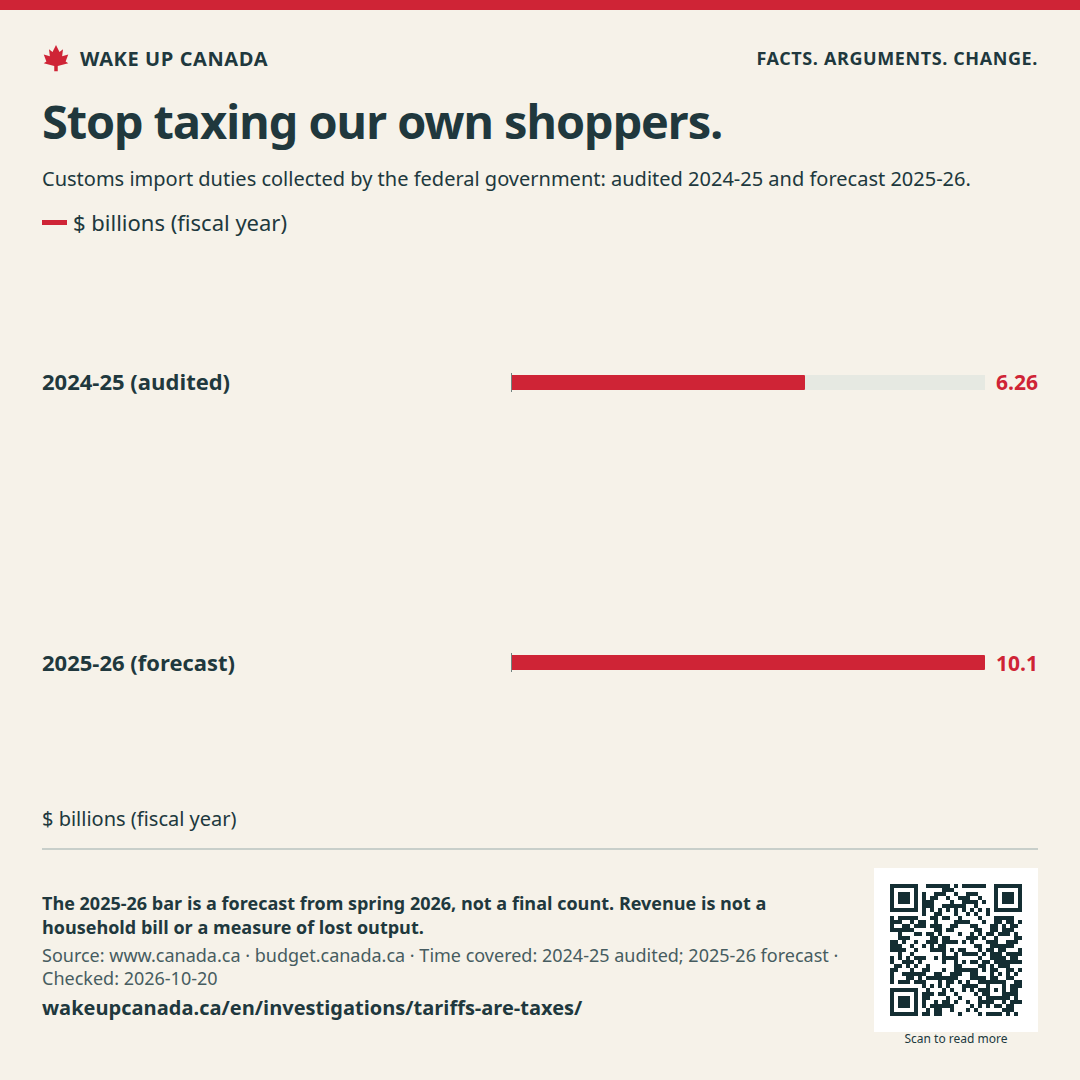
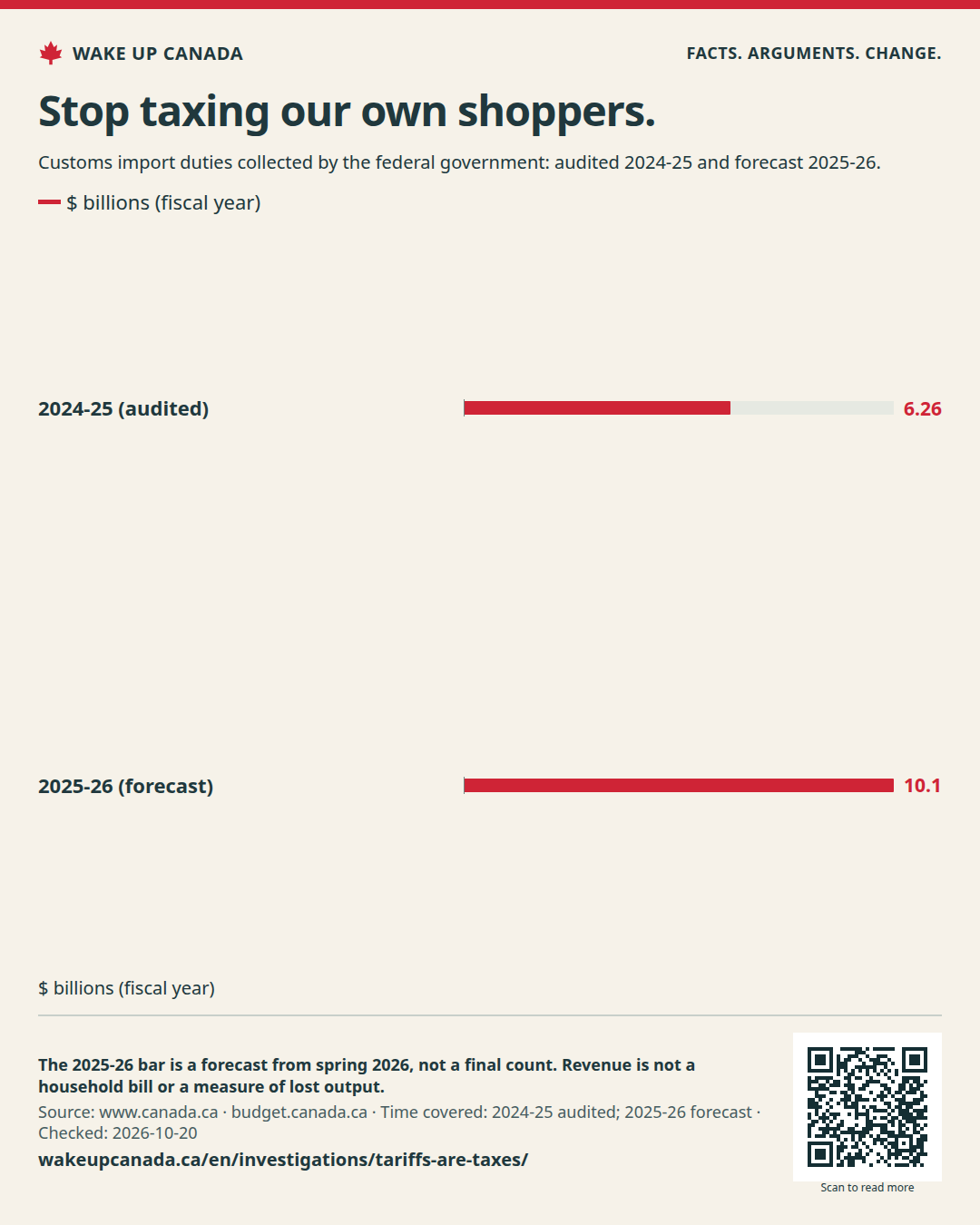
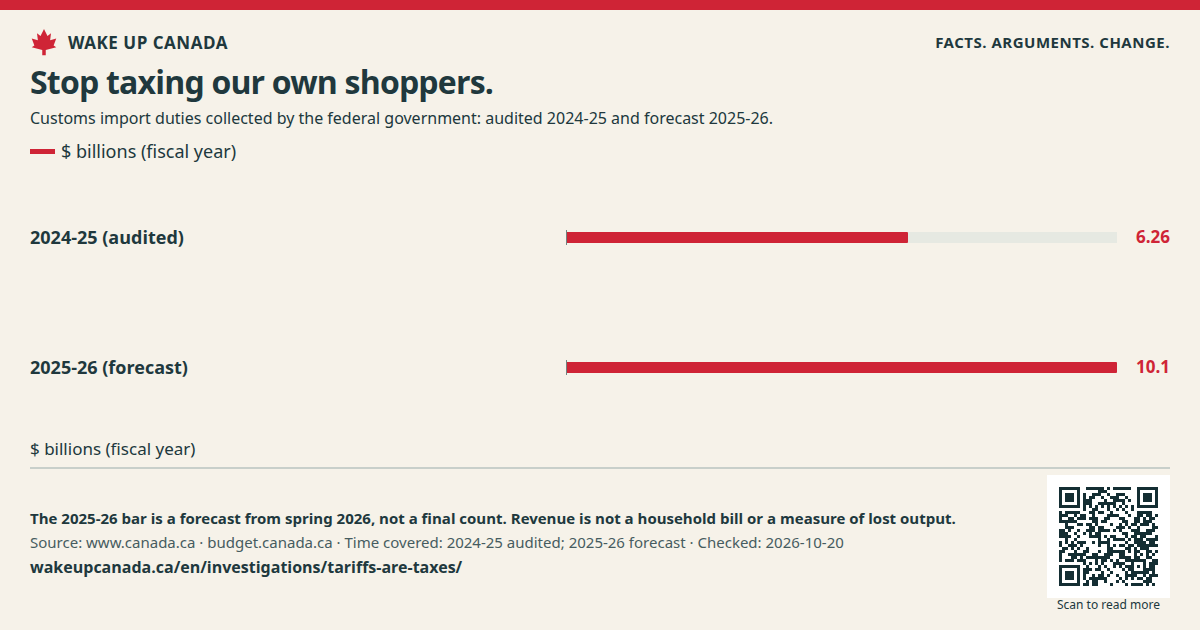
Ottawa took in $6.3 billion in import duties in 2024-25. That is a real budget sum. Divide it by the occupied homes counted in 2021 and it equals about $420 per home. But that is just a scale check. It does not show what a family paid or would save.
The same tax can cost buyers money and raise state revenue. Do not count that money twice. Trades that never happen and costly parts add other costs. We have not priced the full bill for Canada's current barriers.
[4][9][3]Growth needs stronger proof.
Our simple test across 143 economies found a link close to zero between 2022 tariffs and later growth. Most follow-up periods last three years; three last two. Countries differ in too many ways for this to show what tariffs caused. We cannot call a faint link proof of no effect.
Researchers studied 151 countries from 1963 to 2014. A tariff rise of about 3.6 points was linked to output about 0.4% lower five years later. They also found lower output per worker. That study uses a model. It is evidence of harm, not a forecast of the gain from zero tariffs in Canada today.
[12][7]Give builders cheaper inputs.
Inputs are the parts and goods a firm uses to make other goods. The India study found a much larger gain from cuts on inputs than on finished goods. A ten-point input tariff cut raised firm output from the same resources by about 4.8%. The finished-goods result was about 0.32%.
That is a reason to look at the whole chain. A wall that helps one steel firm may raise costs for firms that build with steel. Count both sides. Make Canada a good place to build by giving firms access to safe goods on fair, open terms.
[10]Go to zero for our own sake.
We do not need a promise from Washington to want cheaper parts and more choice here. Canada ended most broad counter-tariffs in September 2025, but kept measures on steel, aluminum and cars. That was not a full move to zero. It cannot tell us how a full offer would work.
Our ask is clear: zero tariffs for every country, including China. End quotas that shield sellers from safe rivals. Keep safety, data, recall and forced-labour rules. Apply those rules to all goods on the same terms. Let buyers choose.
[5][8]Help workers through change.
Trade changes can hurt. The Canadian industries with the deepest tariff cuts in the 1989 deal lost about 12% of their jobs. Their output per worker rose about 15%. Both findings matter. A stronger firm is not a job plan for a worker who lost work.
Publish the lost duty revenue and the cost of real help for workers and towns. State how both will be paid for. Ending a bad tax needs an honest plan, not a promise that no one will lose.
[11][4]The strongest challenge to our case
A model of Canada's 1879 National Policy found a small gain in living standards. The reported whole-economy tests put it at about 0.03% to 0.20% of GDP. That is evidence we must face, not hide.
That study measures a small gain in living standards, not a growth rate. Its tests for the whole economy stay positive. A separate count of losses leaves out trade-price and tax-revenue gains. We must not call that a reversal of the same result. A model of 1879 also cannot settle Canada's best policy today.
[1]What we want changed
Take every tariff to zero.
End all customs duties. Keep rules that guard people. End quotas, permits and country bans used to shield sellers from lawful trade. Keep permits that guard people or enforce sanctions.
Keep the rules that guard people.
Safety, data, recall and forced-labour rules stay — applied the same way to every country.
Fund the change honestly.
Publish the lost duty revenue and the cost of worker help. Pay for both in the open.
Who can act
Parliament can change the tariff law. Cabinet can change many duties under powers that law gives it. A plan to end every duty must use the right legal steps.
What this could cost the public
The 2024-25 duty take was $6.3 billion, about 1.2% of federal revenue. The spring 2026 forecast for 2025-26 was $10.1 billion. Repeal would remove revenue. We have not priced the full gains to buyers or the cost of worker help.